



Cataract surgery is the most commonly performed surgical procedure in the United States, with millions of operations done each year. For patients in Evansville, Henderson, and Princeton, cataract surgery at Hayden Vision is the procedure that restores the clarity they have been slowly losing for years, often without realizing how far their vision has drifted. Here is exactly what happens at each stage.
Why Do Patients Need Cataract Surgery?

A cataract forms when the proteins inside the eye’s natural lens break down and clump together. The lens loses its clarity and starts to scatter light instead of focusing it. The result is the blurry, hazy, washed-out vision most patients describe as looking through a dirty window or driving with a fogged windshield.
The condition is age-related and nearly unavoidable if you live long enough. No medication, eye drop, or pair of glasses can reverse it. Surgery is the only way to restore clear vision once a cataract has advanced.
How Hayden Vision Prepares You Before Surgery Day
Long before the day of your cataract surgery, our team spends significant time on measurements, conversation, and decisions that shape the visual outcome. Detailed imaging of the eye’s shape, curvature, and axial length is taken so the new intraocular lens can be selected with millimeter precision. Any pre-existing astigmatism is mapped, and other eye conditions, such as glaucoma or macular issues, are factored in.
The most important pre-operative decision is which intraocular lens will go into the eye. The choice of lens shapes how you will see for the rest of your life, which is why the lens implant options at Hayden Vision are discussed in detail during the pre-operative evaluation, not on the morning of surgery.
You will be asked how often you read, whether you drive at night, whether you spend hours on a screen, and whether you prefer glasses for some tasks or none at all. Those answers shape the lens recommendation your surgeon makes. By the time you arrive on surgical day, the plan is locked in, and the team is ready to carry it out.
The Day of Your Cataract Surgery, Step by Step
Cataract procedures at Hayden Vision are performed at either an outpatient surgery center or a hospital, depending on which location is most convenient and clinically appropriate. The total time spent at the facility is usually about two hours, though the surgical portion is far shorter than most people expect.
Numbing, Sedation, and the First Few Minutes
There is no general anesthesia involved. Once you are settled, the eye is numbed with topical anesthetic drops, and a mild intravenous sedative places you in twilight sedation.
You stay awake but comfortable, relaxed enough that the experience feels closer to a long blink than an operation. You will not feel the incision being made, and patients consistently report it was easier than they had braced themselves for.
A soft eyelid speculum keeps your eye gently open. You are asked to look at a focusing light overhead. Beyond that, your job is to relax.
The Twenty-Four-Step Protocol
The cataract surgeons at Hayden Vision follow a meticulous twenty-four-step protocol designed by Dr. Hayden, recognized among the Best Cataract Surgeons in America in 2022. Each step has a specific purpose, and each is performed in the same sequence on every patient for consistency.
Three of those steps benefit significantly from femtosecond laser assistance: the initial corneal incision, opening the capsule that holds the natural lens, and breaking the cataract into removable fragments. The femtosecond laser produces openings more circular and uniform than any human hand can manage, and that uniformity matters for how the new lens centers and settles inside the eye.
After the laser portion, your surgeon uses a small ultrasound instrument to gently break apart and remove the clouded lens material through the tiny corneal opening. The capsule, the thin membrane that originally held the natural lens, is left intact. It will hold the new implant in place.
The intraocular lens itself is folded into a small injector and slipped through the same micro-incision. Once inside the eye, it unfolds and is positioned within the capsule. The corneal opening is so small that it self-seals. No stitches are required.
From numbing drops to lens placement, the surgical portion typically takes fifteen to twenty minutes per eye.
Choosing the IOL That Shapes Your Vision Afterward

The lens that goes in is permanent. It does not need replacement, and it will not develop a new cataract.
Monofocal IOLs provide excellent distance vision but typically still require reading glasses for close-up work. They are covered by Medicare and most insurance plans.
Toric IOLs are designed for patients with astigmatism. However, many patients can correct astigmatism during cataract surgery itself with laser-assisted limbal relaxing incisions, depending on their specific prescription.
Multifocal IOLs offer a wider range of vision at near, intermediate, and far distances. Patients who want to read a menu, glance at a dashboard, and recognize a friend across the room without reaching for glasses often weigh whether a multifocal IOL is worth the upgrade, since these lenses are considered elective and add to the out-of-pocket portion of the procedure.
What Recovery Actually Looks Like
Most patients are surprised by how quickly their vision begins to improve. Many notice clearer sight within hours, though early vision can also feel slightly hazy or watery while the eye settles. That is expected.
A follow-up visit at Hayden Vision is scheduled for the day after surgery. Your eye is checked, prescription drops are reviewed, and any questions are answered. Additional appointments at one week and one month track healing.
Full visual stabilization usually takes a few weeks. There are no stitches to remove and no patches to wear after the first night. Most normal activities can resume within a day or two, though patients are asked to avoid rubbing the eye, swimming, and heavy lifting for a short window. By the second week, most people are back to driving, working, and reading.
When It’s Worth Scheduling a Cataract Evaluation
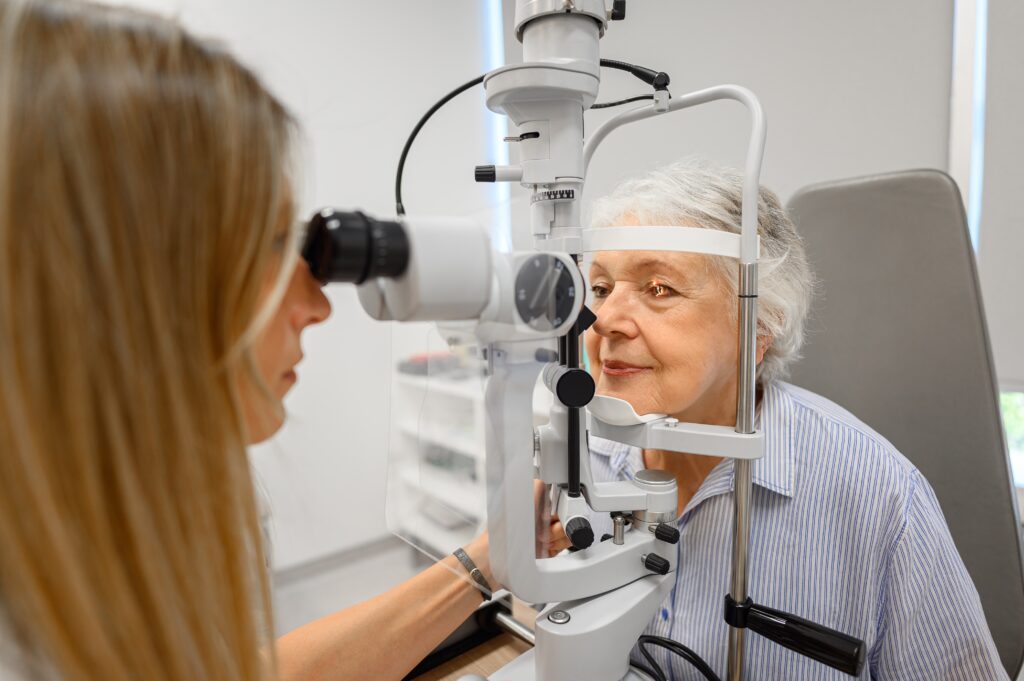
Cataracts develop gradually, and the visual changes can be subtle until they suddenly are not. Frequent prescription changes, halos around headlights, and faded color perception are among the signs that often point toward cataract surgery, and they tend to appear over years, not overnight.
A comprehensive evaluation at Hayden Vision can determine whether what you are noticing is the normal aging of the lens, an early cataract worth monitoring, or a cataract advanced enough that surgery is the better path forward.
Noticing the visual changes that come with cataracts? Schedule an appointment at Hayden Vision in Evansville, IN, today.