



Many people who think about LASIK dream of waking up and seeing clearly right away. Still, not knowing what happens during the procedure can make you feel unsure. It’s normal to have questions about eye surgery.
Knowing each step ahead of time takes away much of that worry. Keep reading for a step-by-step guide to LASIK at Hayden Vision from the first consultation to the final follow-up, so you know what to expect before, during, and after your procedure.
What is LASIK?

For clear vision, light passes through your cornea and lens, which bend it so it lands exactly on the retina at the back of your eye. The retina then changes this light into signals your brain understands as images.
If your cornea isn’t shaped correctly, light doesn’t focus where it should, and your vision becomes blurry. This is known as a refractive error. A normal cornea is round like a basketball, but with astigmatism, it is shaped more like a football. LASIK corrects nearsightedness, farsightedness, and astigmatism by reshaping the cornea so light focuses properly.
Step 1: The LASIK Consultation
Before scheduling surgery, your eyes will be carefully checked. Many people begin with the online LASIK self-test, which gives a general idea of whether the procedure might work for them. The consultation is where you find out for sure.
At your visit, your eye doctor confirms your prescription hasn’t changed in at least a year, measures your refractive error, and reviews your overall eye health. They also measure your corneal thickness and map its surface in detail. These measurements show whether you qualify and help program the laser for your procedure.
Your doctor may also check your tear quality and amount, since dry eye can worsen after LASIK. People with thin corneas, keratoconus, uncontrolled dry eye, or a changing prescription usually aren’t good candidates, and pregnant or nursing people should wait. At Hayden Vision, LASIK fees are all-inclusive, covering the consultation, measurements, procedure, and six months of post-operative care.
Step 2: Getting Ready in the Laser Suite
At Hayden Vision, Dr. Gregory Hayden performs LASIK himself and has over twenty years of experience. Your appointment starts with numbing eye drops. You will not feel pain during LASIK, but you may notice some pressure.
Next, a small eyelid holder keeps you from blinking, and a suction ring holds your eye steady. Many patients say it feels like a finger pressing firmly on the eyelid. Your vision may dim or go dark briefly while the ring is in place, which is normal and passes quickly.
Step 3: Creating the Corneal Flap
Once your eye is numb and steady, your surgeon makes a thin flap on the front of your cornea. At Hayden Vision, we use bladeless LASIK, so a femtosecond laser creates the flap instead of a blade.
The flap stays attached on one side, like a page on a hinge. Your surgeon gently lifts and folds it back to show the tissue underneath. After the procedure, the surgeon puts the flap back in place to protect the treated area, which helps you recover quickly.
Step 4: Reshaping the Cornea
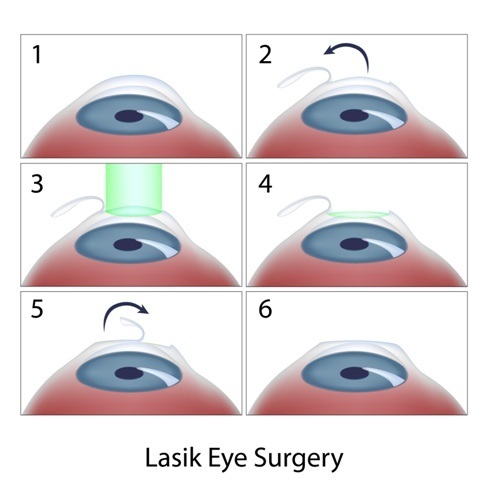
This is the step that changes your vision. You will look at a target light while an excimer laser reshapes the tissue under the flap, using the measurements from your consultation. You will hear a clicking sound as the laser works.
At Hayden Vision, we use only the Allegretto Wave Eye-Q excimer laser. This laser delivers wavefront-optimized treatment and tracks your eye’s position 400 times per second, adjusting for even tiny movements.
The Allegretto Wave also treats a wider corneal zone and leaves a smoother outer edge. Older lasers treated a smaller central area and could leave a sharp edge, which can cause halos, glare, and poor night vision. A smoother surface lets light pass through cleanly, whether you’re outside at noon or driving home after dark.
Step 5: Replacing the Flap
After reshaping, your surgeon repositions the flap and smooths the edges. It starts to seal on its own within minutes, so you don’t need stitches.
Your LASIK surgeon repeats the same steps on your other eye. LASIK usually takes less than 30 minutes for both eyes, but you will spend some extra time at the office before and after the procedure.
Step 6: Recovery and Follow-Up

LASIK is done as an outpatient procedure, so that you will go home the same day. For the first few hours, your eyes may feel scratchy, itchy, or burning. It is best to go home and rest; taking a nap can help you feel better. You may need to wear a clear shield while sleeping for the first few nights and use eye drops to reduce dryness and help healing.
Most people notice clearer vision within a few hours, and many return to work within a day or two. You will return the day after surgery so your doctor can check how your eye is healing.
For about a month, avoid heavy exercise, eye makeup, and swimming to lower your risk of infection. Some dryness and daytime vision changes are common at first and usually go away within a month. Your eyes may take three to six months to heal fully, and your vision can keep improving during that time.
Have more questions about the LASIK process? Talk to the experts at Hayden Vision in Evansville, IN today.